

Tolkien's Psychological Secret to Masterful Fantasy


So, I’m going to go wildly out on a limb here and say Tolkien was a genius storyteller. I know, I know, it’s a hot take. But hear me out. Because even today, with the HUGE influence he had on the fantasy genre, he does some things nobody else in modern fantasy is doing, but nowhere near enough people are talking about the particular choices he makes in telling LOTR that make the story so incredibly effective. And too few people are discussing how, despite his massive influence, he STILL manages to capture the hearts of new generations of readers.
Now, it is true that everyone talks about how he created an incredibly detailed secondary world. But so do many, many authors both before and after Tolkien. Robert E. Howard, for example, created a very detailed backdrop for his Conan stories in the “world of the Hyborean Age”--did he make a bunch of languages from scratch? Ok, no. But that was just Tolkien’s pet project. His languages are indeed beloved, but I’m not talking about that stuff. And other authors like Robert Jordan, Brandon Sanderson, and Steven Erikson all made massively detailed secondary worlds. So I don’t think that’s it. I think it has a lot more to do with the less visible elements of his storytelling. I think he differs in the particular choices he made in scene writing, narrative structure, and above all, the extremely important things he does with point of view, and I want to get into this because of just how massively different his story would have been had he made just a few changes in these areas.
Information Management
So, when I’m writing stories for The Raven’s Tale novels, I always have on my mind something I call ‘information management’. Now that’s just my own idiosyncratic shorthand for dealing with matters of point of view, dramatic irony, and story reveals–I put it under one umbrella term. And every one of the choices you have to make if you’re a writer has major tradeoffs that you’re much better off knowing about than ignoring. Tolkien was, I believe, fully aware of what I’m about to get into here, because he wasn’t just a master of languages, he was an expert in English literature, including Old English, Norse myth, and Celtic myth, legend, and so on.
So what am I really talking about here? Information management is what you have to think about when you’re writing any scene–and it boils down to two major questions: how much does the reader know and how much do the characters know? But you don’t want to just stop there. You want to ask yourself, HOW should I reveal new story information for maximum emotional impact?
And this is where the psychological part comes in. See, the human brain is primed toward seeking novelty. Something unexpected will hold our attention more than something that is considered routine based on what we already know. This starts literally from day ONE in the human mind. Infants, for example, who are only 2 months old will pay extra attention to objects that appear to stop falling in mid-air. At even this young age, our brains notice when something is out of the ‘ordinary’. So how does this help storytellers? How does this explain why Tolkien was so good at this particular storytelling skill?
The Hobbits' Journey
Let me give you some examples so you can see. Let’s start with the journey that the hobbits take to get to Rivendell. It’s not often talked about when writing experts talk about POV but there is much more to the concept of POV than just “is it first person limited, third person omniscient, second person, blahblahblah”. All that does is put a label on the POV choice for one lousy scene. But we’re talking about an entire novel, here. The POV choice affects every scene, yes, but it also affects the entire novel as a whole. And the whole tapestry of POV choices that a storyteller makes impacts the overall power of the story taken as a whole. How often are POVs switched? When? Why? What we should be thinking about in trying to understand Tolkien’s genius is this: every choice of POV Tolkien makes impacts the information management purposes in telling LOTR, and Tolkien found the maximal way of navigating many tradeoffs.
From the very beginning, first of all, we see that LOTR is told entirely from the POVs of the hobbits. Have you ever noticed that? Contrast this to modern fantasy authors, who absolutely LOVE to switch POVs all the time, bouncing here and there. Brandon Sanderson, for example, in the Way of Kings, jumps between Kaladin and Shallon–two characters who don’t even meet one another in the entire book! John Gwynne, in his book Shadow of the Gods, has three completely separate POV characters who go on their own journeys and barely interact in any meaningful way with one another. And let’s not even get into Steven Erikson, who has so many POV characters in his Malazan series, some readers struggle to keep track of them all!
I can’t be certain, but I believe Tolkien would have thought all of these choices were wrong. And the reason is that he obviously paid extremely close attention to POV, taking extreme care to choose when, who, and how he placed each POV. But was he right? And why are modern authors so quick to make such choices in POV? What might have affected these later writers than didn’t affect Tolkien? Is this really new? Well, yes and no. Alexandre Dumas, for example, had quite a few characters in the Count of Monte Cristo whose stories we followed–though there were no instances of Dumas interweaving separate and completely unrelated stories the way Sando, Gwynne, and Erikson do. So, yes, this business with much freer choices of POV characters does seem new.
The Hidden Influence
What might have made the difference? Well, ask yourself this: what might these modern authors have been influenced by that Tolkien and older writers didn’t? Yeah–it’s TV and movies. The visual media has definitely influenced novel writing. And don’t get me wrong, I’m not saying these other authors are wrong or bad for making the choices they made. But you can really tell the influence of visual storytelling on their writing once you make this realization. For my part, I of course, have been influenced by visual media too, and I sometimes employ POV switching, but as we will see, Tolkien was very strict about how he used POV, and in this video I’m going to get into why that is. It inspired me to be much more strict about POV as well, and I’ll explain how I used this analysis to make my own POV choices later on.
So let’s get back to LOTR then–what am I really getting at here? So, on the journey to Rivendell, we know all kinds of other stuff was happening. While the hobbits were chillaxing with Tom Bombadil, Saruman and Gandalf were getting into it. Aragorn was doing ranger stuff, Ringwraiths were hunting about for them, and the Elves were sending out scouting parties to try to determine what was happening. But we don’t see any of that other stuff. Now ask yourself, and be honest, if a modern fantasy author wrote LOTR, don’t you think we would have all kinds of scenes away from the hobbits? Of course we would. Wanna know how I know? Watch the movies–Jackson does exactly this very thing. While Sam and Frodo are gallivanting along the countryside, we directly follow Gandalf to see his confrontation with Saruman. We see scenes from Saruman’s point of view. A modern author would probably have scenes from the Ringwraith’s point of view, elves running about searching for them, and probably a scene of Gollum escaping from Mordor for good measure. Imagining it all in real time, skipping around like a TV show.
Tolkien, however, obviously did not want to do that. He clearly thought that telling his story almost entirely from the POV of the hobbits was the absolute best way to tell his story. Why do you think he insisted on having four hobbits go along with the epic quest traipsing all over Middle-Earth? It’s so that through every journey into all the different clashes of armies and kingdoms, there would be a hobbit there that we could experience the story through. That was not an accident. I’d bet money he set that up in advance and did it on purpose. Notice that there are no scenes from the point of view of Elves, orcs, Ents, or Wizards. Hobbits or humans only! And only a small number of POVs. Not thirty, or, hundreds like Malazan.
And Isn’t that interesting? Why do you think that is? Well, I think, to understand why, you need to understand what exactly you’re doing if you’re a writer and you decide to split your story up into different POVs like this. Modern authors, raised on TV, seem to think that jumping across different POVs and following characters that don’t even cross paths with one another is the better way to tell a story. Perhaps they feel it’s better because it means you can cover a lot more ground, and follow more interrelated stories. In Story Grid terminology this is known as a ‘microplot’, where you follow a lot of characters as they all orbit one larger story as it develops across a huge span of place and possibly time. So writers of epic fantasy love to do this for this very reason, I think.
What are the Tradeoffs?
But does this mean LOTR isn’t Epic? No, obviously not! It is INSANELY epic. In fact, it is difficult to describe the feeling you get at the end of Return of the King, the ending comes down so hard, and so heavy. It’s massive–much like the ending of Beowulf, which Tolkien of course knew very well. But Beowulf isn’t epic because of all the POV characters–it doesn’t have that many. Nevertheless, Beowulf is also quite short compared to massive works like the Wheel of Time, or the Stormlight Archive. Thus, the larger cast of POV characters does definitely give a feel of epic sweep, since you’re following not just one story but many stories surrounding one super-story. So, again, I’m not criticizing the technique, rather, I’m asking, what are the tradeoffs of doing this? What does a storyteller pay to gain this boost in epic sweep? And why, of all people, did JRR Tolkien feel that this price was too high?
Let’s use another example so I can show why I think he did this, and why the WAY he did it gains in ways you might otherwise not notice. We have an amazing example we can analyze here in the extended version of Jackson’s Return of the King: the scene of meeting the Mouth of Sauron at the Black Gate. In the movie, we see in a previous scene how Frodo was stripped of his mithril shirt, and after the orcs stop fighting each other, one orc sneaks off. After this, we cut to Aragorn, Gandalf, Merry and Pippin at the Black Gate. The Mouth of Sauron comes out, and he taunts Aragorn and company with the mithril shirt. He says “know that he suffered greatly at the hands of his host” and all that.
Dramatic Irony
So at this point I have digress a little–this is an example of dramatic irony. Now there are two major kinds of dramatic irony that I’m going to get into here. The first is where the characters know more than the audience does, and the second is where the audience knows more than the characters do. Information management. Now, dramatic irony is inherently interesting because of the novelty. Our brains love it, because you’re not just seeing things happen to people, you’re seeing them, while your expectations don’t match the characters, so you naturally want to know how it’s going to play out. In the first type of irony, since the storyteller is withholding information from the audience, it’s very interesting because I want to see what the character who knows more than me is up to. What are they doing and why? It draws you in. In the second type, you can set up the classic Hitchcockian bomb-under-the-table scene, where you know the bomb is there, but the characters don’t, and there’s tension about how it will play out. Other variations in dramatic irony, naturally, exist. For example, you might have the kind of irony employed frequently in Shakespeare, where two characters are talking about a third character, but they don’t know the third character is listening. Human brains are extremely social brains, and figuring out who knows what about who is called in psychology “theory of mind” and it’s another one of these skills we are innately obsessed with.
Another kind of irony is employed in Don Quixote, where we see Don Quixote and Sancho blindfolded and riding on a wooden horse, and while they think they’re going on a magical journey into the sky, we know the snotty nobles are just playing pranks on them. The irony in Don Quixote, by the way, is absolutely masterful–it’s funny, and sad, and poignant, and inspiring all at once. There’s a reason it’s one of the greatest novels ever written. That scene in particular really got to me–it’s both absolutely hilarious and terribly sad at the same time because of all the irony in it. Don Quixote’s wholehearted belief in the absurd is endearing and inspiring, actually, and makes you wonder if the sober, reductionistic worldview that everyone else has is really all that preferable. Gorgeous, and very deep.
But I want you to remember something very important here: every storytelling decision comes with tradeoffs. Creating scenes with dramatic irony comes with powerful storytelling gains if used well, but it also has tradeoffs. The job of the storyteller is to decide whether the tradeoff is worth it. Tolkien was a master of this, and you’re going to see why. So, back to the Black Gate. Jackson tells this story in the way we’re all used to after decades of TVs and movies teaching us the lexicon of storytelling common to that medium. You can shift POVs instantly in a TV show and very quickly get settled into a new POV because 1. You don’t really get into the heads of the characters in a TV show anyway, 2. You have an actor that can quickly orient and embody a new character, and 3. The visual medium orients you very quickly to where you are and what’s happening. So POV shifts are less costly in TV than they are in the written word. Jackson, knowing we are expecting this kind of storytelling, unravels the convoluted way Tolkien writes these same scenes, and tells them in the standard TV- or movie-style because Jackson knows what he’s doing.
But What About Written Media?
But hold on a second. Let’s see how Tolkien does it. Remember, the Two Towers and Return of the King are broken up into two parts each. In The Two Towers, we first follow Merry, Pippin, and Aragorn for half of the entire book. Only then do we switch gears, going back in time actually, to the point of the breaking of the Fellowship, to find out what Sam and Frodo were doing this whole time. This going back in time, I think, is probably why Jackson decided not to do the story exactly the way Tolkien did–in the visual medium we’re all used to, this would require an awkward “meanwhile, three months ago”, followed by the second half of the season following only Sam and Frodo. In a TV show, you’d just bounce back and forth between them.
But doing it this way costs the storyteller in a way that is not immediately obvious unless you really look closely at it. The Two Towers ends in a huge disaster. Frodo seems dead, he is captured by orcs, and Sam looks like he’s going to have to go alone. That is the point Tolkien stops to switch back to Merry and Pippin. From there, all the stuff happens until you get to the Black Gate. Now, in the movie, we’ve been jumping back and forth, so we know WAY more than Merry and Pippin do about what happened to Frodo and Sam. But in the book, we have absolutely no idea. And when the Mouth of Sauron shows up and hands over the mithril shirt, saying he tortured Frodo to death, we have to stop and ask ourselves–is that actually what happened? How could he have that mithril shirt? But look at the way Tolkien writes that scene a bit more closely and you might notice a few more things. The Mouth of Sauron never mentions Sam. Not even a little. Curious, isn’t it? Now, my dad told me that the wait to get to the Return of the King was agonizing given how The Two Towers ended in such a cliffhanger. But now all that’s gone. Everyone knows.
But isn’t that scene exquisite in its complexity but also its information management? Sure, there’s no dramatic irony at all here. We know just as much as Merry and Pippin do–and it’s terrifying because of it! See, that is the price that you pay, in this instance at least, for making the choice of POV in this case.
The Hidden Costs
See, as effective as dramatic irony can be, you have to know the cost of employing it. Irony, no matter what kind it is, distances the audience from the characters. It pulls you back and invites you to look at the situation the characters are in. It’s very thought provoking, and it can be a powerful method of developing your theme, too–witness the masterful way Shakespeare and Cervantes employ it. But the price you pay in employing irony is in emotional connection and immersion in the characters’ world. And this cost is paid even if you’re not really using the POV shifting in service of irony or theme. It happens even if you’re only doing it, as I suspect many fantasy authors in particular are, so that you can showcase some part of the secondary world, and/or for ease in introducing a plot element that would be more difficult if you limited yourself to a given POV. But this limitation is exactly what Tolkien does. By limiting his POV characters only to hobbits and later to a few humans, he makes sure his world is only ever seen through the wonder-filled eyes of the hobbits, who are our stand-ins. Gandalf, Sauron, and Ringwraiths all remain mysterious, terrifying, and wondrous because we never really get into their heads. In The Raven’s Tale, I don’t limit myself quite this much, but I have several rules I don’t break. First is that no scene will use a POV character that has not previously been referenced. And second, if I employ dramatic irony, you can bet that I’ve thought this through and weighed the options the best I could, because I value emotional immersion very highly, and I am loathe to give that up unless for a very good reason, and there are some instances where I do.
How many modern authors do you think would have been able to resist having scenes from Sauron’s point of view, up in his tower, wreathed in flame and all that, ordering his Ringwraiths to “stick to ze plan”, etc., etc. Make sure you include a cliche scene where he kills a minor minion for failing him. Now, the decision NOT to show Sauron has a tradeoff too. What is the cost of never showing us Sauron? Well, even though it maintains his mystique and his looming menace, it makes Sauron feel like a very distant threat, abstract, almost unreal. Tolkien counter-balances this, however, with his secondary villain, and one might argue the true villain of the story: the One Ring itself. It’s right there, right in your head, right in your hand, threatening you with evil you can’t destroy. It’s brilliant–but that’s another subject for another day of Tolkien analysis.
For now, let’s look at the very psychological way in which Tolkien crafts his story with his choice of information management. Now, in the first kind of irony I described, where the characters know more than the audience, the tradeoff is that you have to go to extra lengths to ensure that we actually CARE about what the characters are doing. Because you’re creating a wall between the audience and the characters using irony, you have to account for it and make sure you use other techniques besides the raw immersive effect of keeping the information balance to make sure the audience cares.
In the second kind of irony, where the audience knows more than the characters, you have a different set of tradeoffs you have to manage. First is that you are separated from the characters as you get with all kinds of irony. This is the shouting-at-the-screen kind that horror movies often suffer from. You have two major problems to manage here: first, is that if you’re not careful you can make your characters seem like idiots because they aren’t seeing what the audience knows is there. I’ll give an example of this in a minute. But second is the problem I see with a lot of epic fantasy, where you frequently have characters sitting and talking solely for the purpose of getting them caught up to what the reader already knows. I won’t name any names, but there are more than a few fantasy series’ that suffer from this issue, and it can be tedious for the audience. Are there ways around this? Yes, but I’m just saying, the way the brain works when reading, it’s a tradeoff you want to be aware of when writing, or analyzing, a story, and if you’re just reading or watching a show and find yourself drifting, ask yourself is this is why? In any case, if the storyteller is using irony like this, instead of the way Cervantes, Hitchcock, or Shakespeare use it, it might not be worth it for a temporary increase in tension in the moment.
The Horror TV Show "From"
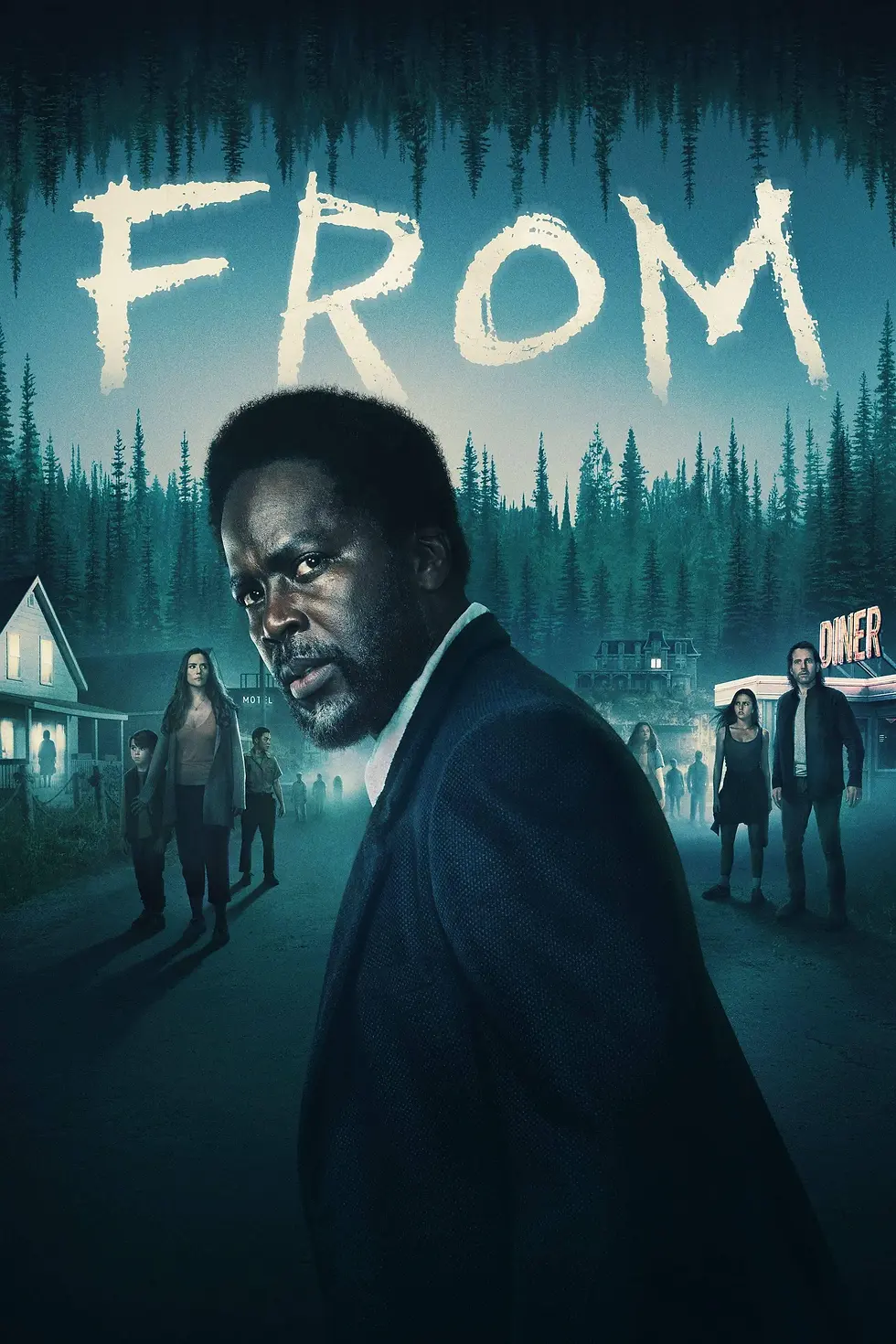
Let me give an example of this that I think really illustrates what I’m talking about. There is a popular TV show out now called “From”, and without any spoilers, it's about a small town where people get trapped and can’t leave, and every night these weird people come out of the ground and they can’t be killed, and they try to prey on the townsfolk by ripping them apart with their bare hands. It’s quite weird. And for the most part, From keeps us tied very closely to the POV characters, and it works really well, because there are constantly bizzare things happening and we see it just as the protagonists do–i.e., they have absolutely no idea what is going on or why, and we don’t know either. It works great because the showrunners resist the urge to have scenes where the villains are all sitting around twirling their moustaches and discussing their evil plan. The payoff is big, because we are shouting right along with the protagonists at the villains saying “why are you doing this to us?” and the fact that they just grin and say nothing makes it all the more chilling.
But there is a plotline where I think they fumble this a bit, and very light spoilers for season 4, so, you’ve been warned, but there is a character introduced at the beginning of the season who we clearly follow as they infiltrate the townsfolk in disguise, gleefully doing evil deeds under everyone’s noses. So, this is obviously employing the second kind of irony I talked about earlier. Every time this character shows up, there is a lot of tension, because WE know that person is evil, but nobody else does. But the cost, for me, isn’t quite worth it. It makes the townsfolk seem clueless and maybe even a little stupid, and it just winds up being frustrating. This is all the more noticeable because the showrunners have deliberately NOT done this sort of thing for any of the rest of the show. Now, it’s not a dealbreaker at all, I still like the show a lot, and I’ll definitely be there next year for the final season. But it did make me wonder–what if they had decided NOT to do this? What if, instead of just telling us about the villain immediately, they forced us to follow the protagonists the way they did previously, and make this new villain plot about discovering a mystery. That would have kept us nailed in their shoes just like before, and living through all the nightmares they were living through. For me, the distance this subtle shift introduces isn’t worth the tension it creates, even though modern audiences are so habituated to it they likely didn’t even notice. I feel like there could have been a fun reveal late in the show when the person they thought was innocent turned out to be a horrible villain causing stuff only hinted at earlier.
What do You Think?
So anyway, there you have it–and even though Peter Jackson made an amazing trilogy, in my mind the best trilogy of movies ever made–the changes he made to the way Tolkien told the story only really work better in the visual medium, and you can make the argument that filming it more closely to the way Tolkien wrote it, with infrequent POV shifts and time jumps and all that, might still work even better than the already incredible movies do. Who knows for sure?
But what do you think? Do you think Tolkien knew what he was doing when he wrote LOTR exactly the way he did? Or should he have employed different storytelling techniques? Should he have gone for more overt irony? Or is it perfect just the way it is? Learn about my fantasy stories on erentyr.com, and thanks for joining me here at The Imaginarium.
EG


Comments